It’s coming up in January! Here’s the information. Please come if you can. Love to see you there!

Here are a couple of reviews!

Here are the links: Outskirts Press Amazon Goodreads, and Barnes & Noble.
Thanks for checking it out.
It’s coming up in January! Here’s the information. Please come if you can. Love to see you there!
Here are a couple of reviews!
Here are the links: Outskirts Press Amazon Goodreads, and Barnes & Noble.
Thanks for checking it out.
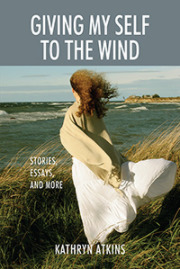
Giveaway ends December 20, 2017.
See the giveaway details
at Goodreads.
Give YOUR self to the wind
. . . and receive the gift of love.

 This published book, Giving My Self to the Wind, is a way to say ‘I was here.’ I stole that idea from Thomas Kail, the director of Hamilton. I hope he doesn’t mind if I borrow it because it’s true. A headstone doesn’t do it, and I cannot hold my kids responsible for substantiating my existence.
My 298-page (!) book opens with a quote by Gustave Flaubert that also explains why I wrote and published Giving My Self to the Wind (GMSTTW): “The art of writing is the art of discovering what you believe.” Isn’t that why most people write?
The collection’s title comes from the penultimate line of a poem I wrote in my teens. My adoptive mother embroidered the poem word for word in a sampler: a photo of it is inside the book. The sampler became a source of inspiration, and a reason to write.
This anthology represents stories, essays, poems, character sketches, and a few articles. I cover many topics, themes, and sins. For that reason, I included an index! Without being over-the-top dense, the index saves the readers’ time. What’s in it? Thong underwear. Aging. Adoption. Coming of age. Unmarried and pregnant. Snoring. Caffeine. A fort! A convertible. Pain. Showing up. Meditation. Pajamas. Writing naked. Hookers. Dancers. Cell phones. Letters to my bio mom and dad are in there. I never met either one of them, I don’t think.
Writing a book is the height of courage if you don’t mind the depths of fear and deep plunge into the “sin” of pride. So, every artist of every kind faces the same angst, and I’m willing to hang it out because, in fact, it does say ‘I was here” in a way that not even my kids, or a photo, or a memory can do. Or a headstone.
How I wish I could hibernate for the next thirty years — no make that twenty — so I could suddenly wake up feeling old and being okay with it. Gray hair: check. Wrinkles everywhere: check. White eyelashes: check. Liver spots (ugh): check. I’m all here, but I’m calm in my old age and not fighting to be a young old person coloring my hair, wearing ingénue clothes, working at breakneck speed to keep up with a race for new technology that I cannot win.

And there I would be, coming out into the light of day, stretching, yawning, squinting from the glare; nearly falling from the atrophy of unused muscles; my hair long like Rip Van Winkle’s, my fingers gnarly and stiff from arthritis, but all of the trappings of being old are hanging happily on my psyche because it’s okay to look old at the age we all know is finally old.
It used to be that fifty-five was old. People retired then. Next, the age went to sixty-five, jumping some invisible chasm from which retirement definition comes in non-dictionary form, to be suddenly the number chronologically at which one turns out the lights to one’s office for the last time. You close the blinds, turn off the computer, turn to look one last time at the place you called work, and bend down to pick up the box full of stuff that you accumulated and that they cannot keep for the next desk jockey to house your spot: your nameplate, your own crystal tennis ball paperweight from your twenty-first birthday; pictures of your mom and dad when they were young; a completely different century where horse-drawn carriages still peppered the byways.
Your handcrafted leather-handled letter opener combination staple remover (you always used it for both) and pictures of your children, your grandchildren, all four of your dogs and the last picture your youngest child drew in watercolor class in fifth grade are all there. He became a famous chef and caters to the rich and famous in a snooty New York City restaurant with and unpronounceable name meaning “Chicken Feed” to those in the know and who care. Most people don’t. And you’ve just had your last treadmill test; the ticker is ticking, like a well-oiled time bomb wanting to blow up the thing you have deftly called life, but you’re not really sure anymore. It could be something else — a dream, a play, or a movie.
* * *
Here’s my life at eighty-seven.
I’m a little old lady in tennis shoes, a member of the Red Hat Society; purple dresses, traveling with a carpetbag. I’m feisty and spry. I have no kids, no husbands, no PTAs no big house to clean, no laundry to speak of. I have an herb garden and tomatoes in pots. Where am I? I’m spending long days and cozy nights by a fake fireplace in a tiny, neat condo near a park. I live in a small town with a university at its center; I take classes and walk in the woods. I put up the tomatoes, write stories and essays, make mosaics, try to play the piano, and read to the kids at the local library, acting out the parts with wide eyes, arching eyebrows and big arm gestures. The children squeal with delight as I act out Little Red Riding Hood or Stella Luna to these lucky few that aren’t so mesmerized by television and computers that they actually enjoy the story. I’m happy in my tennis shoes. Happiest still in a pair of old-lady pedal pushers or jeans and baking brownies. Or not. No one really cares. I’m the only one I need to do for now. Yes, I like seeing the grandkids, but I don’t want them over every day. Oh. But they’re here today.
“Grandma Kaffrum, Grandma Kaffrum,” they call me now. “Can you help us make a blanket fort?”
I love blanket forts. I made them with our kids until they became quite the edifices that surpassed my talents: the kids had a dining room, living room, and TV room, all separated out nicely in their blanket forts, and I was proud. Going deftly and carefully from one soft-sided room to another without pulling the walls down with bigger clumsier feet than those of my little boys made me happy. And letting them sleep in the fort was a special treat for special kids. I remember the time when “closets” were added with boxes and masking tape, and doors made out of appliance box flaps had “Keep Out” signs emblazoned in big block letters with the skull and crossbones to scare away the meek and tender. Flashlights made strange light forms on the ceiling as the rays bent and twisted through the blanket folds.
I miss those times and hope for their return when I wake up from my next hibernation. As in why not?
This is a terrifying time of year for me. In order to get ‘the holiday thing’ done, I now find myself faced with bedroom, kitchen, and office drawers that make me want to throw up. They symbolize my disorganization by distraction as I dart to the next task without closure on the last.
During the year when I have a moment, I’ll madly clean out a drawer and either throw things away or whisk them to their proper place. Afterward, I am smug and smitten with my new pristine storage area, and beam every time I open the drawer to experience its emptiness, discipline, and minimalism. I glow with excitement as I make a solemn vow to keep the drawer in exactly this state forevermore. A few weeks go by, and the next thing I know, I’m staring into this same drawer― I swear, it’s the same drawer—and there’s other stuff in it. Mostly, it’s lots of stuff that shouldn’t be there. Damn!
It’s quite clear what happens. A friend is coming over, or my in-laws, or a co-worker and I rush to straighten things up. Or I’m up against a deadline, and rather than taking an offending, non-conforming item to its proper place, I thrash it into the nearest drawer.
My local office supply store manager perks up when he sees me walk in his front door. For me, it’s worse than a candy store and I always over spend. I like the systems, the boxes, the dividers, and the color-coded doo-dads to help keep things in their categories. I usually seek his counsel after having spent thirty minutes looking for something I never found, and I’m gung ho for the newest system.
However, I don’t know if all the organization schemes in the world will help. Messy drawers are a symptom. My closet gets out of control, too. And the garage, and the trunk of my car, and the kitchen cabinets. I KNOW where everything goes, but sometimes, it’s across the room or across the house, and there just isn’t time!
Am I being anal? Obsessive-compulsive? Maybe conflicted. I like things neat, but I also like the idea of having an existence that keeps me on the run, making me feel like I have a life. What kind of person has so much time on their hands that every drawer is always perfect? I sometimes think that when my drawers are too neat, I am not letting my creative side out. Busy, productive people, I say to myself, have messy drawers and sometimes messy rooms. But that makes me crazy! I stress over this, but I have learned that some people work well in chaos, and others, like me, don’t. It’s whatever you can stand, I guess.
In sum, I guess I just have to be more vigilant about keeping my drawers the way I like them. Or on the other hand, I have to decide that in the long run, it really doesn’t matter. On my deathbed, as they say, I’m not likely to be wishing I’d spent more time cleaning out my drawers.
Con El Alma Dance Recital
The night before a recital. 
Flamenco practice done.
The dancers are ready.
Their hair in buns.
Their feet are sore
From practicing every night.
Excited and happy,
Their goal is to delight.
Filled with elation.
Full of anticipation.
Feeling exhilaration.
There’s never a temptation
To back away.
No way, no way.
Attack. Stay.
Dance. Sway.
Sweat ‘til you’re wet.
Don’t forget. Don’t forget!
Smile.
Grimace.
Spin.
Keep the beat.
More heart. More heart.
Feel the passion!
Meet your art.
The newbies in awe
Watch the seasoned dancers dance.
With hope, with work,
We may have a tiny chance
To be half as good some day.
We sigh, as we say,
“Look. Just look.
They’re lovely to behold.
We’ll be there one day
Before we’re old!”
Flamenco is hard—much harder than it looks.
It cannot be learned from reading books.
Our teacher, dear Sarah
Works tirelessly, but has fun.
Thanks. Sarah. We’re excited.
Break a leg everyone!
© Kathryn Atkins 2016
Author’s note: Whatever you do, you’re bound to face the fear of failure when you’re first starting out. Flamenco so inspires me, I’m willing to face that fear. Eventually I’d like to dance with abandon and revel in the beauty, sensuousness and passion of this historically significant, culturally rich dance form. Until then, I’m willing to learn, practice, and embarrass myself, even, to reach my goal. Olé!
It didn’t start out to be about me, but it was. In fact, it’s not about me! But LOL, it is about me. And it’s about lots of other folks like me who were adopted without knowing who their real parents were. And still don’t.
A reporter in the HARO (Help A Reporter Out) space needed a few quotes about adoption. I replied that I was willing to help her. The reporter, Chandra Evans, interviewed me and the result is in this article, which turned out to be quite a lot — more than I thought she would be using.
It did get me to thinking about what happened back then, and about the meaning of life. We’re who we are from our genes. YES, I did 23 and me to see who I really was, but the numbers aren’t me. I am me. My brother, Bob, is my brother (also adopted). My adopted mom and dad were my mom and dad. That’s the whole banana right there.
Did “23andme” give me closure? No. But life (I say this all the time, and some people don’t like it) is a crapshoot. No guarantees as to where, when, how, or to whom you are born. Life happens to us all, and what we make of it after we’re here is why we’re here.
Finding out why is what makes it fun. Finding out why is what makes us nuts. Whether you’re adopted or not makes no difference, really.
Remember: Steve Jobs was adopted. ‘Nuf said.

Deadlines are the lines drawn in the sand, the air, and on calendars. They are imaginary lines past which one should not go, or you’ll die. Die of what? Failure? Disappointment? Losing a job? Not answering a need? Shame?
Deadlines are a form of communication. “I need this by noon so we can move forward on the project.”
There should be no room for negotiation in a deadline. There is no room for negotiation in death, is there? So why do people push up against deadlines by crushing the work to be done up against the wall of the deadline? To see if it will move? Will it give in like a loose door, or an unsure mother or father? Kids know this instinctively. Will the rules change if we keep ignoring them? Will Mom and Dad change their minds? Will my manager forget? Will the rule/deadline go away in the rush of life?
Some of us use faraway deadlines like beacons for purposeful activity, plotting steps from A to B in the final goal to arrive at Point Z. Others of us assume that there’s still plenty of time and that there’s no use getting all excited — nothing can be gained by starting too early, they say. It wastes time to start too soon, they say. Besides, working under the pressure of a close deadline works in in their favor, they think, as in, “I work better because I’m more focused if time is short.”
Oh? What if your computer breaks? What if the electricity goes out? What if you get sick? What if?
I like deadlines. I like setting up a meeting… it gives me a deadline. I like to be early, to have room and time to make one last pass, one final reading, a once over to see if I left a sponge in the abdomen of my patient before they wake up. (I wanted to see if you were paying attention!)
There’s the Leonard Bernstein quote to throw in here, too. “To achieve great things two things are needed: a plan and not quite enough time.” I think that’s the reason deadlines are SO important. Somewhere along the creative lines of life, the concept of not quite enough time leads us to finality. If we didn’t have deadlines, we would continue to fix, trim, and self-edit until nothing ever, ever was produced. “Perfect is the enemy of good,” as they say. Someone has to say those three wonderful words, “It is done!” (“Not I love you,” which are another three wonderful words.)
I like the pressure and excitement of a looming deadline, but sometimes, just sometimes, I procrastinate… to feel that teeny rush. Shucks. My cover is blown.
I write about the things that I would like to do better. Largely because I’m not perfect. Until I am, then, I’ll remain ever faithful to setting deadlines, and hopefully keeping them, unless the other deadline… the big one, like in a database somewhere with my name on a date… keeps me from my deadline here in this plane.
 Death sat curled up in a large swinging wicker chair in the long shuttered Garden of Eden. The warm breeze smelled of plumeria. A colorful macaw bobbed on a branch of that famous tree. The snake near the tree knew who the beautiful woman was, and recoiled from her, even though she really had no jurisdiction over the animal kingdom. Still the snake stayed his distance.
A bright green frog peeked up from under a leaf. The rest of nature’s creatures crowded around in a careless exhalation of extraordinary beauty. Death went there sometimes to think things through. She loved the natural habitat and the irony: the Garden of Eden had actually been the beginning of the end: the birthplace of man’s mortality. Had those two humans (symbolic or not) never been “human” by succumbing to temptation, they would not have known death or Death, either one. The latter smiled at the irony.
Did Adam and Eve not know these words at the time: “… and lead us not into temptation, but deliver us from evil…”? Death decided they didn’t know or chose not to heed the words because they were lead into, and they were not delivered from. The forbidden fruit was the temptation on that fateful day. Today, the Deathlist is the forbidden fruit. It’s man’s quest to know all there is to know. And this knowledge, this Deathlist, has been as nasty and unforgiving as the sin in the Garden of Eden. And as before, they’re paying for it.
“But perhaps we can still fix it,” Death said to those creatures around her. “The Deathlist that is. Adam and Eve’s little slip is way too far gone. But the Deathlist… maybe yes.”
Death arose from her chair, nodded to the pretty frog and raised an eyebrow in the snake’s direction. He flinched. Death chuckled, pleased with herself, and left.
© Kathryn Atkins 2016
 Eternity — it was the last thing I thought about when I died. I was supposedly going someplace (as they say) for a long time. In fact, they say the place you go will be the place you stay for the rest of time. I cannot fathom this any more than many people can fathom living with the same person for all one’s lifetime. But the fathomability of all things varies with each person’s fathom factor, which may change as one ages, or may be one of those things stapled onto your DNA as much as your eye color or your baldness factor. I would like to think we have seasons of fathomability.
Spring sees growth in everything. Change is the order of the day; newness rules: buds, leaves grass, trees, chick, puppies, bunnies, all that stuff. Everything is new and feels good; anticipation sprays the air with an aroma of future, excitement, lust and baseball, for those that like the sport, which I don’t. But I do know spring. I like spring. It hits me in different ways all the time. I crave that edge, that indefinable “What’s next?” that pushes me to know it’s time to energize my creativity and push forward to the next thing. God will steer me as he has always done. Spring rocks.
Summer pushes a hold button — a lazy sit in the sun and read button that carries suntans and waterskiing and vacations in its bag of tricks. It’s the end of school days for some, a marked change of pace regardless of schools just because it’s hot. Swimming pools fill, beaches overload, air conditioners do, too. I can only hope the summer of my eternity isn’t the same heat as the rest of my eternity, or I’ve really goofed, unless lazy is the button I push and I have a lazy eternity — which I can’t like very much, unless that’s what I’m supposed to learn in my eternity, because I haven’t learned it here.
Fall is my second favorite season. It’s transitional. It’s beautiful. While preparing for the cold winter eternity, it begins with a cooling of the evenings even if days stay hot through October here. And then, the colors burst in a crescendo — only to fall like my ability to be clever at the end of a long day of pushing against that heavy door hoping to find something, anything on the other side. Sometimes we’re lucky. Those are the good days. Sometimes we have to keep pushing. I am able to fathom an eternity of fall. It’s a beautifully crisp, stout and sure season that lets in passion. Yes. That works.
Finally, the winter does come, covering me in negativity: a dirty snow. It’s not the white fluffy snowflake snow, but the coal-gray, smoky, slushy, shoe-wrecking snow of the city. So, I cannot fathom this eternity because spending the rest of my time in a dirty-snow city would suck. My fathom factor for an eternity of winter is exactly zero. Maybe minus something.
It could be important to question where we’ll spend eternity. I don’t know. Maybe instead, we should ask in what season we are spending our lives. For we don’t really know there is an eternity. In fact, eternity might be right here. Right now. Who’s to know, really?
